A new survey report from the International Foundation of Employee Benefit Plans reveals U.S. employer coverage and considerations surrounding glucagon-like peptide-1 (GLP-1) drugs, which have historically been used to treat diabetes. These drugs were also found to cause weight loss and have been subsequently used to treat obesity.

Among survey respondents, 76% provide GLP-1 drug coverage for diabetes, 27% provide coverage for weight loss, and 13% are considering covering for weight loss.

In 2023, the average representation of GLP-1 drugs used for weight loss in employers’ total annual claims was 6.9%, according to survey respondents. Those who are covering GLP-1 drugs are relying heavily on utilization management (79%) to control costs. A less common approach (32%) is step therapy. Fourteen percent of employers have no cost control mechanism in place.
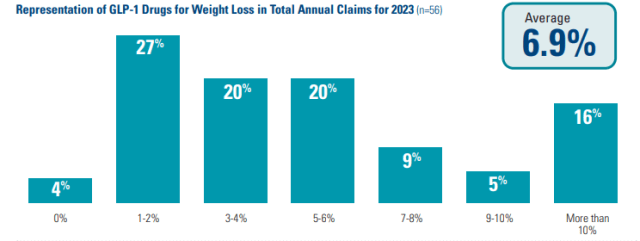
“Though GLP-1 drugs have a high price tag, they currently represent only 6.9% of annual claims, according to survey respondents,” said Julie Stich, CEBS, Vice President of Content at the International Foundation. “Employers can take this information into account when designing long-and short-term benefit strategies.”

The most prevalent factor employers take into consideration for GLP-1 drug coverage for obesity care include:

  • Obesity as a risk factor for chronic conditions and associated costs—63%
  • Long-term costs—55%
  • Impact/effectiveness of cost-control mechanisms—54%
  • Broker/consultant/PBM recommendations—50%
  • Lack of long-term use clinical studies of GLP-1 drugs—46%

Find more information and view the latest GLP-1 Drugs survey report.

Anne Patterson

Associate Director, PR and Communications Favorite Foundation Product: Foundation Community. It’s like LinkedIn but only for Foundation members. They can post questions, share best practices, etc—all with fellow members who also live and breathe employee benefits. Benefits-related Topics That Interest Her Most: Mental health, diversity, equity and inclusion, behavioral decision making, family-forming benefits, payroll audits. Personal Insight: When she’s not busy keeping up with her two little ones, Anne finds joy in home renovation and décor, haiku writing, watching Jeopardy, crafting charcuterie boards, and bicycling.

Recommended Posts

The Multiemployer Retirement Plan Landscape Report: Defined Contribution Key Findings

Cathe Gooding, CEBS
 

The health of multiemployer defined contribution (DC) retirement plans improved from 2021 to 2023, according to The Multiemployer Retirement Plan Landscape: A 15-Year Look (2009-2023), recently released by the International Foundation of Employee Benefit Plans.

Benefits to Grow and Support Families: A Ten-Year Look

Anne Patterson
 

Fertility, family planning and family support benefits have been steadily on the rise as employers seek to attract and retain talent, support workforce well-being and build more inclusive workplaces, according to the International Foundation’s Employee Benefits Survey: 2026 Report.

Supreme Court Rules in Withdrawal Liability Case

Kathy Bergstrom, CEBS
 

In a unanimous ruling on May 21, the Supreme Court affirmed a circuit court decision and held that pension plans have the flexibility to update actuarial assumptions after year-end when calculating withdrawal liability rather than fixing those assumptions at the close of the prior year.